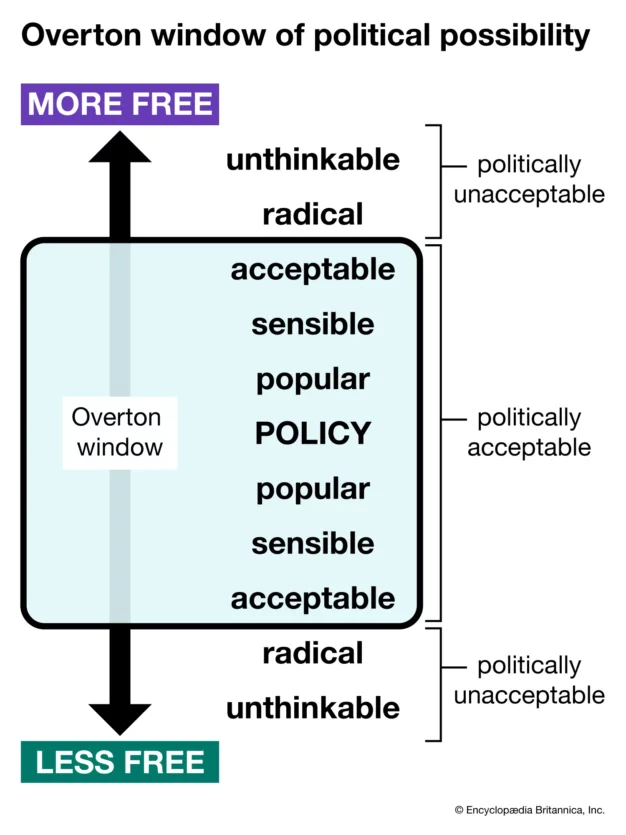
The Overton Window is the range of ideas a society considers acceptable to say out loud at a given moment. It’s named after Joseph P. Overton, an American policy analyst who described it in the 1990s. His point was simple: politicians rarely lead. They pick from what the public already accepts.
Important: The window itself isn’t good or bad. It’s a thermometer, not a moral compass. What matters is who moves it, how fast, and in which direction. The window used to move like a glacier. It took a generation for ideas to shift from fringe to mainstream. Today it moves at the speed of a feed. Three things changed:
- Speed. Algorithms reward what provokes. The more extreme a statement, the further it travels, and the faster repetition makes it feel normal.
- Who holds the lever. Once it was parties, newspapers and think tanks. Now it’s influencers, meme accounts, AI-generated content and anyone with a viral clip.
- Fragmentation. There’s no longer one window. Every bubble has its own. What’s unthinkable in your feed might be common sense in your neighbour’s.
That’s why so many of us feel disoriented. It’s not that we’ve lost our compass. It’s that the map keeps being redrawn while we’re reading it.
My long time believe: watch the artists. They’re usually standing at the edge of the window long before the rest of us notice it has moved. In disorienting times, the smartest move isn’t to cling to what used to be normal. It’s to keep your eyes open, know where the edges are, and decide with intent which side of them you want to stand on.